You see paraquat as a very poisonous herbicide. It works fast to kill weeds and grasses. Farmers use this herbicide to manage weeds and control grass. They also use it to dry crops before picking them. Paraquat comes in different types. Some examples are Paraquat 200 g/L SL, Paraquat 276 g/L SL, Paraquat 250 g/L SL, Paraquat 42% TK, and Paraquat 45% TK. People use paraquat on land that is not farmed or has hard-to-kill weeds. Paraquat is a dangerous chemical. Only people with a license can use it in many places. More than 32 countries have banned or stopped using paraquat. These countries include China, Brazil, Switzerland, and countries in the European Union. They did this because of health and safety worries. You should learn about paraquat to keep yourself and others safe.
Key Takeaways
Paraquat is a very dangerous herbicide. People use it to kill weeds and grass fast. Only people with a license should use it. This helps keep everyone safe.
You can get exposed to paraquat by eating it, breathing it in, or touching it. This can cause serious health problems. It can hurt your lungs and poison your body.
Many countries do not allow paraquat because it is risky. It is linked to Parkinson's disease. Always check your local rules about paraquat.
It is important to be safe when using paraquat. Wear safety gear. Read the labels closely. Follow all safety steps to avoid accidents.
If you come into contact with paraquat, act fast. Take off any dirty clothes. Wash the area that touched paraquat. Get medical help right away to lower health risks.
What is paraquat
Chemical properties and names
You might ask, what is paraquat in science? Paraquat is a chemical that kills weeds very well. Its full chemical name is 1,1'-dimethyl-4,4'-bipyridinium dichloride. Scientists also call it paraquat dichloride. You can look at its main chemical facts in the table below:
IUPAC Name | Molecular Formula |
1,1'-dimethyl-[4,4'-bipyridine]-1,1'-diium dichloride | C12H14Cl2N2 |
Paraquat is part of a group called viologens. These chemicals can easily gain or lose electrons. This makes paraquat good for killing weeds. You will see paraquat in products like Gramoxone and Gramoxone INTEON. These products have different strengths, such as Paraquat 200 g/L SL, Paraquat 276 g/L SL, Paraquat 250 g/L SL, Paraquat 42% TK, and Paraquat 45% TK.
How paraquat works as a herbicide
Paraquat is a nonselective contact herbicide. It kills almost any green plant it touches. When you spray paraquat on weeds, the leaves soak it up. The chemical goes into the plant cells and messes up important jobs. Here is how paraquat works step by step:
You spray paraquat on the plant’s leaves.
The chemical gets inside and stops the electron transport chain in photosystem I.
This makes harmful molecules called reactive oxygen species (ROS).
The ROS hurt the plant’s cell walls, proteins, and DNA.
The plant cannot make energy, so it wilts, turns yellow, and dies.
You can see what paraquat does in the table below:
Mechanism of Action | Description |
Electron Acceptance | Paraquat takes electrons from ferredoxin in photosystem I (PSI). |
Superoxide Production | This makes superoxide, which turns into reactive oxygen species (ROS). |
Cell Damage | Too much ROS breaks cell walls, causes yellowing, and wilting. |
Paraquat works very fast. Weeds start to die just hours after you spray. The herbicide does not move in the soil. It only hurts the plants you spray. This helps you kill weeds without hurting crops if you are careful.
Note: Paraquat is very poisonous to mammals, including people. It can badly hurt your lungs if you breathe it in or swallow it. Always wear safety gear when using paraquat dichloride.
Main uses in agriculture
You will see paraquat used in many farm jobs. Farmers like it because it works fast and kills many weeds. Here are some main ways to use paraquat in farming:
Weed and grass control: Paraquat kills many kinds of weeds. You can use it to clear fields before planting or to control weeds between crop rows.
Desiccation: Farmers use paraquat to dry crops like cotton before picking. Drying crops helps make harvesting easier and faster.
No-till farming: Paraquat helps no-till farming by killing weeds without digging up the soil. This keeps the soil healthy and stops erosion.
Uncultivated land: You can use paraquat on places not farmed, like fence lines, roadsides, and industrial areas, to keep them free of weeds.
The table below shows some crops and how paraquat is used:
Crop Type | Use of Paraquat |
Cotton | Used before harvest to remove leaves and control weeds. |
Corn and Soybeans | Kills grass and broadleaf weeds, even in tough spots. |
Rice | Controls weeds in paddies, works on water grass and duckweed. |
Vegetable Crops | Kills weeds in tomatoes, potatoes, and cucumbers when other ways do not work. |
Pre-planting | Put on soil or seed beds to kill weeds before crops grow. |
You will find paraquat in many product types, like Paraquat 200 g/L SL, Paraquat 276 g/L SL, Paraquat 250 g/L SL, Paraquat 42% TK, and Paraquat 45% TK. These help you control weeds in big fields or small gardens.
Tip: Always read the label and follow local rules when using paraquat dichloride. You need training and safety gear to use it safely.
Paraquat poisoning and health risks
How paraquat poisoning occurs
Handling paraquat can be very risky for your health. This chemical can get into your body in different ways. You might swallow it by mistake, breathe it in, or get it on your skin. Each way can be dangerous.
Route of Exposure | Description |
Ingestion | Drinking paraquat by accident from a drink container can poison you. |
Inhalation | Breathing in spray drops can cause nosebleeds and breathing problems. |
Skin Contact | Touching paraquat can hurt your skin, especially if you have cuts. |
Touching paraquat with bare hands is more dangerous if you have cuts or sores. Stronger paraquat makes the danger even worse. You need to wear gloves that protect against chemicals and a respirator when using this herbicide. Always use closed tools for mixing and moving paraquat to stop accidents.
Symptoms and effects of poisoning
You should know the signs of paraquat poisoning. The symptoms can show up soon after you are exposed. Even a little bit can make you very sick.
Stomach pain
Feeling confused
Losing water from your body
Fast heartbeat
Weak muscles
Low blood pressure
Feeling sick and throwing up
Pain and swelling in your mouth and throat
If you swallow paraquat, your mouth may swell or burn. Just a small sip of a 20% solution can kill an adult. Paraquat is one of the most dangerous herbicides because it is so toxic. Any exposure needs quick medical help.
Long-term health impacts (Parkinson’s disease, organ damage)
Being around paraquat for a long time can cause serious health problems. You could get lung damage, kidney failure, or other organ issues if you use paraquat a lot. Even small amounts over time can hurt your health for years.
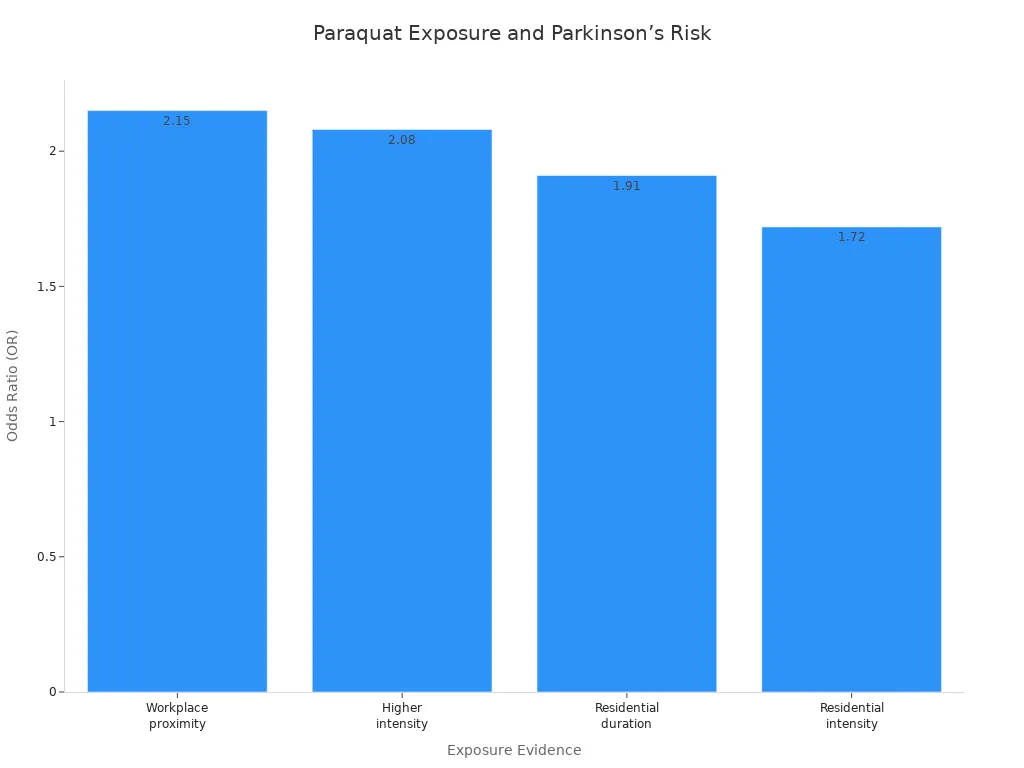
Many studies show a strong link between paraquat and Parkinson’s disease. Scientists found that paraquat can change the brain in ways seen in Parkinson’s disease. If you live or work near places where paraquat is used, your risk goes up.
Evidence Description | Odds Ratio (OR) | Confidence Interval (CI) |
Workplace proximity to paraquat applications | 2.15 | 1.46, 3.19 |
Higher average intensity of exposure | 2.08 | 1.31, 3.38 |
Residential proximity duration | 1.91 | 1.30, 2.83 |
Residential average intensity | 1.72 | 0.99, 3.04 |
The risks do not stop at Parkinson’s disease. Bad poisoning can also hurt your lungs and kidneys. These health problems can last a long time or never go away. You must always follow safety rules to protect yourself from paraquat.
Note: Paraquat poisoning is very serious. If you think you were exposed, get help right away. Acting fast can save your life.
Paraquat exposure and safety
Who is at risk of paraquat exposure
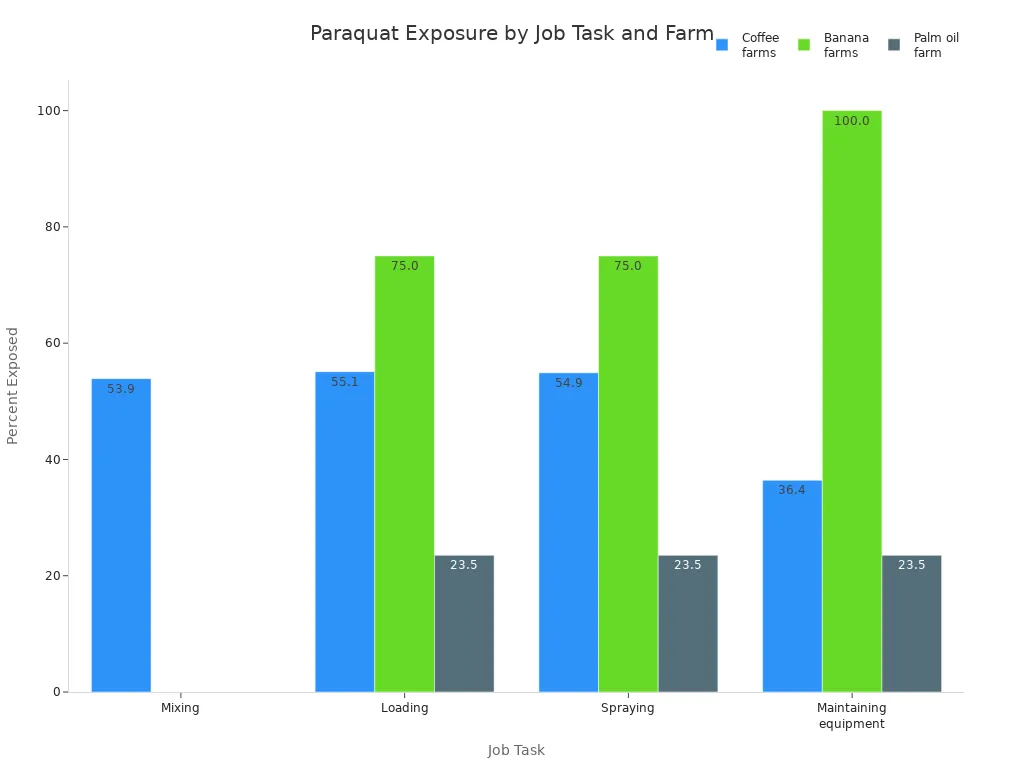
You are at risk if you work with paraquat on farms. Farmers and workers who mix, load, or spray it have the highest risk. People who live near fields sprayed with paraquat can also be exposed. The table below shows how different jobs affect workers on coffee, banana, and palm oil farms:
Job tasks | Coffee farms | Banana farms | Palm oil farm |
Mixing | 53.9% | 0% | 0% |
Loading | 55.1% | 75.0% | 23.5% |
Spraying | 54.9% | 75.0% | 23.5% |
Maintaining equipment | 36.4% | 100% | 23.5% |
Older people, those with less schooling, and blue-collar workers have more health risks from paraquat.
Safety measures and protective steps
You must follow safety rules when you use paraquat. The EPA says only trained people can mix, load, or spray it. Training teaches you about paraquat’s dangers, how to read the label, and what happens if you use it wrong.
The training gives you facts about paraquat’s dangers, label rules, and what can happen if you do not use it right.
Manufacturers put blue dye in paraquat so you do not mix it up with drinks. It also smells strong and has something that makes you throw up if you swallow it. Some experts say this may not always work, but these things still help lower the risk.
To stay safe, always:
Be careful every time you use paraquat.
Read the label and know emergency numbers.
Wash your hands and face after using it.
Clean and check your tools often.
Wear gloves, goggles, and clothes that protect you.
Keep paraquat locked up and sealed.
Throw away empty bottles the right way.
Learn the newest safety rules.
What to do if exposed to paraquat
You need to act fast if you think you were exposed to paraquat. Quick action can help you get better and lower health risks. The table below shows what to do first:
Step | Action |
1 | Take paraquat off your body right away. |
2 | If you swallowed it, use activated charcoal or Fuller's earth to stop it from getting in your body. |
3 | Doctors may use a tube to remove it from your stomach if you swallowed it less than an hour ago. |
4 | Get help like IV fluids, breathing support, or dialysis. |
5 | Do not give too much oxygen because it can make things worse. |
6 | If it gets on your skin, take off dirty clothes and wash with soap and water. |
7 | Rinse your eyes with water for 10-15 minutes if needed. |
8 | Put dirty clothes in a plastic bag to keep others safe. |
Getting medical help early, like washing out your stomach or cleaning your blood, can help you survive. Always call for emergency help if you think you have paraquat poisoning.
Tip: Knowing the signs of paraquat exposure and acting fast can save lives.
Paraquat regulations and controversies
Legal status and restrictions worldwide
You need to know that there are strict rules for paraquat. In the United States, the EPA makes many rules to keep people safe. Only certified applicators can use paraquat. You cannot put it in food or drink containers. You must lock it up so kids cannot get it. It should be stored far from homes. You cannot use paraquat near gardens, schools, or playgrounds. Always follow the label and wear safety gear. New bottles help stop people from drinking it by mistake. The EPA also says when you can go back into fields. Workers must wear extra safety equipment.
Here is a table that compares rules in different places:
Country/Region | Licensing Requirement | Training Requirement |
United States | Classified as a Restricted Use Product (RUP) | Must be licensed and undergo training every 3 years |
European Union | Banned paraquat | N/A |
Other Countries | Varies, many have banned paraquat | N/A |
More than 30 countries, like the European Union, China, and Switzerland, have banned paraquat. They say it is too toxic and dangerous for health.
Bans, lawsuits, and public debate
Many countries banned paraquat to keep people safe. The European Union, China, the United Kingdom, and Switzerland do not allow it because of health risks. In the United States, paraquat is still legal but has many rules. There are many lawsuits. People say paraquat made them sick with Parkinson’s disease and other problems. For example, in September 2024, a person in Colorado sued for injury. In November 2024, there were over 5,800 lawsuits against companies that make paraquat.
People talk about these main points:
Paraquat is very toxic to people.
Studies show it may cause Parkinson’s disease.
Some countries ban it, but others do not.
Paraquat stays in the environment for a long time.
Ongoing regulatory changes
Many countries are changing their rules for paraquat. Germany, France, the United Kingdom, and Italy have banned it or set strict limits. Russia made new rules that make the market smaller. In the United States and Canada, paraquat is still allowed but has many rules. Groups and companies like Syngenta help make new rules and do more studies. They work with experts to answer safety questions and change the laws.
Note: You should always learn about new rules and news. These changes can affect how you use paraquat and how you stay safe and protect the environment.
You now know that paraquat is a strong weed killer. It can be very dangerous for your health. You should always watch for new safety rules and laws.
Leaders and doctors want tougher rules because paraquat is linked to Parkinson’s disease and other sicknesses.
People are suing companies and signing papers to ask for better laws.
You can stay safe by following the rules and asking experts for help.
Date | Update |
2021 | EPA made new rules to lower risks from paraquat. |
January 2026 | California will stop people from using paraquat. |
Keep learning about paraquat. Make choices that keep you and others safe.
FAQ
What should you do if you accidentally touch paraquat?
Take off dirty clothes right away. Wash your skin with soap and water for 15 minutes. Get medical help as soon as you can. Acting fast can lower health risks.
Can you use paraquat in home gardens?
You cannot use paraquat in home gardens. Only people with a license can use it. This rule keeps you and your family safe from poisoning.
How long does paraquat stay active in soil?
Paraquat sticks to soil particles very tightly. It stops working fast and does not move in the soil. You do not need to worry about it getting into groundwater.
Why do some countries ban paraquat?
Many countries ban paraquat because it is very toxic and risky for health. These bans help protect workers, people living nearby, and nature from accidents.
 English
 العربية
 Français
 Русский
 Español
 Português
 Deutsch
 italiano
 日本語
日本語 한국어
한국어 Nederlands
 Tiếng Việt
 ไทย
ไทย Polski
 Türkçe
 አማርኛ
አማርኛ ພາສາລາວ
 ភាសាខ្មែរ
 Bahasa Melayu
 ဗမာစာ
ဗမာစာ தமிழ்
தமிழ் Filipino
 Bahasa Indonesia
 magyar
 Română
 Čeština
 Монгол
 қазақ
қазақ Српски
 हिन्दी
 فارسی
فارسی Kiswahili
 Slovenčina
 Svenska
 українська
 اردو
اردو বাংলা
বাংলা Basa Jawa
 मराठी
मराठी ਪੰਜਾਬੀ
 తెలుగు